The National Congress of American Indians Task Force on Violence Against Women will provide an update on efforts to remove barriers preventing American Indian tribes and Alaska Native villages from Read More ››
The social, political, and cultural instability during the colonial era and American Revolution involved ongoing warfare, shifting allegiances among Indigenous and European nations, enslavement, and Read More ››
Connecting the Dots: An Overview of the Links Among Multiple Forms of Violence is a publication of the Centers for Disease Control and Prevention and Prevention Institute. Read More ››
FVPSA is the primary federal funding source dedicated to supporting immediate shelter and supportive services for victims of family violence, domestic violence, or dating violence and their Read More ››
Both the Indian Child Welfare Act and the Violence Against Women Act tribal jurisdiction provision (section 904) recognize the inherent sovereignty of Indian Nations to protect their women and Read More ››
The newly established Tribal Safe Housing Center was created to address the intersection of housing instability/homelessness and domestic violence. Read More ››
Out of all women in Hawaii, Native Hawaiian women face the highest percentage rates of domestic violence and sex trafficking. In order to address this violence, the Pouhana O Nā Wāhine was founded. Read More ››
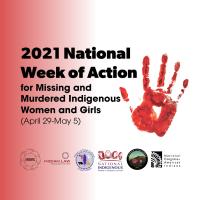
The National Indigenous Women’s Resource Center (NIWRC) invites you to join us to honor missing and murdered Indigenous women and uplift the voices of surviving family members. Read More ››
In some tribal communities, American Indian women face murder rates more than 10 times the national average. In responding to this national crisis, we recognize systemic barriers that exacerbate effor Read More ››
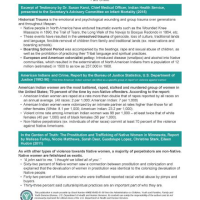
During the period of 1979 through 1992, homicide was the third-leading cause of death of Indian females aged 15 to 34, and 75 percent were killed by family members or acquaintances. Read More ››
In 2005, the national movement for the safety of Native women led the struggle to include in the Violence Against Women Act a separate title for Native women called Safety for Native Women. Read More ››
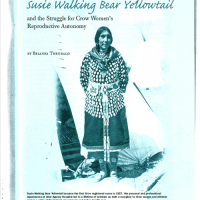
Written by Brianna Theobald. Coercive sterilization of Indigenous women at Crow Agency, and the activism of Indigenous women, has a longer history than scholars have recognized. In the late 1920s and Read More ››
The National Indigenous Women’s Resource Center (NIWRC), the National Congress of American Indians (NCAI), and the Alaska Native Women’s Resource Center (AKNWRC) will host a webinar to summarize key national concerns and emerging issues for Tribal leaders and representatives to consider in advance of the 18th Annual Government-to-Government Violence Against Women Tribal Consultation. Read More ››
VAWA 2005 requires the DOJ, HHS, and DOI to engage in formal consultation with Indian tribes on an annual basis to address concerns that impact the safety of Indian women at the broadest level. Read More ››
On May 3, 2019, President Trump became the first President to formally recognize Missing and Murdered American Indians and Alaska Natives Day. Read More ››
This sample proclamation aims to assist Tribal leaders and advocates in their efforts to proclaim October as Domestic Violence Awareness Month across Tribal Nations, Alaska Native villages, and Read More ››
This sample proclamation aims to assist Tribal leaders and advocates in their efforts to proclaim April as Sexual Assault Awareness Month across Tribal Nations, Alaska Native villages, and Indian Read More ››
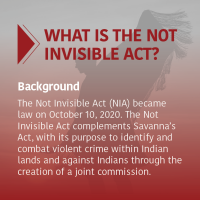
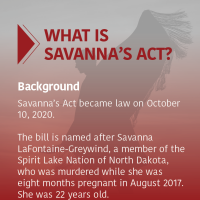
Savanna’s Act (The Act) became law on October 10, 2020. The bill is named after Savanna LaFontaine-Greywind, a member of the Spirit Lake Nation of North Dakota, who was murdered while she was eight months pregnant in August 2017. She was 22 years old.
This webinar provides an overview of the Full Frame Initiative’s project (FFI) to understand how people who have experienced domestic violence define success for themselves, and how others in the Read More ››
Together We Are Stronger
Indigenous Women's Movement to End Violence Against American Indian, Alaska Native, and Aboriginal Women
United Nations Church Center Chapel
March 22, 2016 Read More ››
The National Indigenous Women’s Resource Center (NIWRC) invites you to learn more about the complex and ongoing Missing and Murdered Indigenous Women (MMIW) crisis. Read More ››
VAWA 2005 requires the DOJ, HHS, and DOI to engage in formal consultation with Indian tribes on an annual basis to address concerns that impact the safety of Indian women at the broadest level. Read More ››
Description: VAWA 2005 requires DOJ, HHS, and DOI to consult with Indian tribes on an annual basis. This interaction on a nation-to-nation basis has allowed tribal governments and the United States to Read More ››
Outdated Census definitions and poor data quality have led to a misunderstanding about the size and significance of the rural Native American population. Read More ››
While advocacy on the domestic level is vital, violence against American Indian and Alaska Native women also has implications in the international arena. Read More ››
Five years ago, Congress passed the Violence Against Women Reauthorization Act of 2013 (VAWA 2013).2 In response to the high rates of domestic violence being perpetrated against American Indian and Read More ››
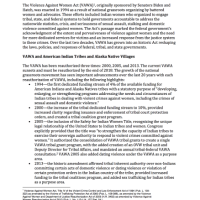
The Violence Against Women Act (VAWA), originally sponsored by Senators Biden and Hatch, was enacted in 1994 as a result of national grassroots organizing by battered women and advocates. Read More ››
Hear from Native survivors and their advocates about what women need in the short and long term, & how our grassroots organizing movement continue to change the culture of and prevent DV. Read More ››